

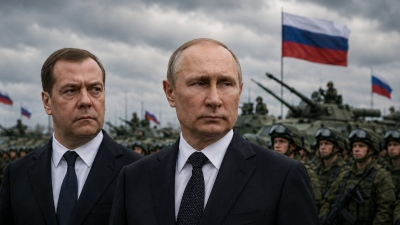
In a speech filled with strong symbolism, clear martial messaging, and a significant domestic political dimension, Vladimir Putin used the 23rd Congress of the United Russia party to present Russia as a nation that, despite war, sanctions, and external pressure, seeks to appear united, politically stable, and determined to pursue the strategic course it has charted.
The timing was by no means accidental.
The second phase of the congress took place on August 22, the day Russia celebrates State Flag Day, while the party simultaneously enters the home stretch for the State Duma elections.
The congress had as its primary goal the approval of the new political program of United Russia.
Vladimir Putin chose this precise symbolism to link the domestic political front with the war in Ukraine.

The flag as a symbol of war and state continuity
At the beginning of his address, the Russian President congratulated citizens on State Flag Day, presenting the tricolor not merely as a state emblem, but as a bridge between history, contemporary military operations, and the country’s future.
In the Russian political narrative, the flag now acquires a dual role.
On one hand, according to the Kremlin, it symbolizes the continuity of a great historical path.
On the other, it has transformed into a direct symbol of the war, as it is raised by Russian units in territories captured in Ukraine, which Moscow characterizes as liberated.
Vladimir Putin linked this imagery with a broader message of national cohesion: Russia, as he argued, constitutes «one people» called upon to jointly defend the country, its interests, and its state sovereignty.
Here lies perhaps the central political message of the address.
For the Kremlin, the conflict in Ukraine is no longer presented solely as a military operation.
It is described as a test for the entire Russian state and as a confrontation surrounding its historical direction, security, and ability to make decisions independently of the West.
«The harder it gets for the adversary, the more violent the attacks»
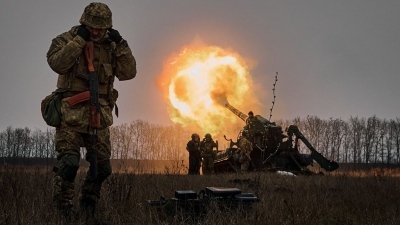
Particular weight was carried by the reference of Vladimir Putin to Ukrainian strikes against targets inside Russia.
The Russian President directly linked the increase in these operations to the situation on the front line.
«The more difficult the situation becomes for the adversary at the front, the more severe and barbaric the attacks carried out by the Kyiv regime», he stated.
He then spoke of the «neo-Nazi», «Bandera», and «Russophobic» nature of the adversary.
At a strategic level, however, the argument that Moscow is attempting to build is clear: long-range Ukrainian attacks are framed by the Kremlin not as a sign of military initiative, but as a reaction to the pressures faced by Ukrainian forces on the front.
This specific narrative allows the Russian leadership to integrate even strikes that cause damage inside the country into a broader message: Russia is under attack because the adversary is losing on the battlefield.

War while advancing major state projects
A second significant element of the speech was the effort by Vladimir Putin to dispel the image of a nation operating exclusively in a «state of war».
He acknowledged that Russia faces numerous challenges.
At the same time, however, he maintained that it continues to plan and implement large-scale projects, development policies, and technological programs.
The logic is vital for Russian political strategy.
The Kremlin seeks to demonstrate to both domestic and international audiences that the war and Western sanctions have failed to paralyze the state or disrupt its long-term economic functioning.
Available Russian economic figures indeed show that the economy has not collapsed, although growth rates have decelerated.
Rosstat estimated annual GDP growth in the second quarter of 2026 at 1.3%, while the Ministry of Economic Development estimated growth in the first half of the year at 0.6%.
For the Russian leadership, these figures serve as an argument for resilience.
Russia is not merely surviving against external pressure, but is simultaneously attempting to build greater economic, technological, and strategic autonomy.
«Unity between the front line and the home front»
Vladimir Putin placed particular emphasis on the concept of social unity.
The strength of Russia, according to him, lies in the values inherited from previous generations, as well as in the bond between the front line and the home front.
This phrasing carries distinct political significance.
The Russian leadership understands that a prolonged war is not decided solely by soldiers, drones, ammunition, and factories.
It is also determined by the ability of the state to maintain the consensus of a broad segment of society, fund social needs, and prevent a deep divide from forming between citizens and the state’s wartime goals.
That is why the United Russia party is attempting to tie its electoral platform to issues extending beyond the war: demographics, the labor market, regional disparities, the economy, technological development, traditional values, and security.

Elections amidst war
Equally notable was the reference of Vladimir Putin to the functioning of electoral institutions.
The Russian President stated that the country has no intention of abandoning the principles of popular sovereignty, even under the most demanding conditions.
«The people are the source of power», he said, adding that elections at various levels will continue to take place throughout the entire territory that Russia considers its own, «from the Far East to Novorossiya and the Donbass».
Medvedev: The seven major challenges
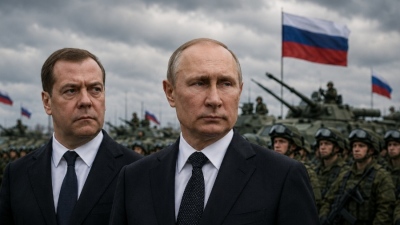
Dmitry Medvedev, chairman of United Russia and deputy chairman of the Security Council, struck a more aggressive tone.
Dmitry Medvedev argued that Russia is moving toward victory and that following the conclusion of the conflict, the primary mission of the state will be ensuring economic growth, security, and sovereignty.
At the same time, he outlined seven major challenges around which the party’s new political agenda is built: demographics, human capital and the labor market, regional development, the economy, technology, preservation of traditions, and security.
Already during the preparation of the new «people’s platform», United Russia had presented these categories as the foundation of its future priorities.
What is noteworthy here is that even a political leadership employing martial rhetoric recognizes that the biggest gamble for Russia is not confined to the operational field.
Demographic decline, the need for specialized personnel, regional disparities, and technological independence are problems that will persist even after the war ends.

The harder line of Medvedev
Dmitry Medvedev once again used far sharper language toward Ukraine and the European Union.
His reference to Ukraine as «Country 404» forms a characteristic part of his personal political rhetoric.
He has repeatedly used the term to question the viability and political trajectory of the Ukrainian state.
He also predicted that more territories will come under Russian control, presenting this development as a continuation of Moscow’s military trajectory.
He was equally fierce toward current European leaders, using harsh characterizations and linking them to the historical legacy of fascism.
The true message of the congress
The Russian leadership wants to show that it does not view the war as a temporary parenthesis that froze the normal functioning of the country.
On the contrary, it attempts to present Russia as a state that has adapted to long-term confrontation, integrated the war into its political and economic framework, and is already preparing for the day after.
Vladimir Putin spoke of the flag, historical continuity, popular unity, elections, sovereignty, and growth.
Dmitry Medvedev added the harder martial dimension, while simultaneously putting demographic, economic, and technological problems on the table.
This combination is revealing.
Moscow seeks to signal to its adversaries that it does not expect a quick return to pre-2022 conditions.
Domestically, it attempts to convey a different message: that despite the war and external pressures, the Russian state is planning its future with an outlook far beyond the next military operation.
However, the political message of Vladimir Putin on August 22 was unmistakably clear: Moscow wants to demonstrate that it does not treat the current conflict as a crisis it must merely survive, but as a test from which it aspires to emerge more sovereign, more self-sufficient, and more deeply consolidated.
www.bankingnews.gr



Σχόλια αναγνωστών